A moon in the dark night- Science Based Medicine-Harriet Hall

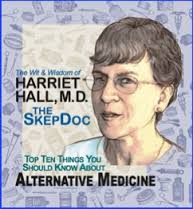
(Harriet Hall, MD, also known as The SkepDoc from her column of that name in Skeptic magazine, is a retired family physician and former flight surgeon who retired from the Air Force with the rank of colonel.
She writes prolifically about medicine, so called alternative medicine, science, quackery, and critical thinking. She is an editor of the Science-Based Medicine blog where she has contributed an article every Tuesday since the beginning of 2008. She is also a contributing editor of both Skeptic and Skeptical Inquirer magazines, and a Fellow and Executive Council Member of the Committee for Skeptical Inquiry (CSI).
She is co-author of the textbook Consumer Health: A Guide to Intelligent Decisions and author of Women Aren’t Supposed to Fly: The Memoirs of a Female Flight Surgeon.)
Our ancestors lived in a pre-scientific world where the evolution of “logically illogical” thinking helped them survive.Science doesn’t come naturally; we prefer stories to studies. How can we decide if a medical treatment works? The scientific method is the only way to get reliable answers. Evidence-based medicine was a good idea but failed to live up to its promise.How science-based medicine is different from evidence-based medicine and why it is better.)
Lecture 1: Science-Based Medicine vs. Evidence-Based Medicine
Science is a recent development.
Evolution shaped our brains to survive as hunter-gatherers; our thinking is “intelligently illogical.”
We are so good at pattern recognition that we see patterns that are not real.
We tend to jump to conclusions.
We prefer to get information from stories than from studies: we are unduly impressed by anecdotes.
Science is a way of correcting for human misperceptions and cognitive errors, and scientific thinking doesn’t come naturally.
How can we know if a medical treatment works?
Unsystematic observation of apparent cures is often misleading.
o Bloodletting fooled doctors and patients for centuries
o Surgery that was believed to work for heart disease proved to be no better than sham surgery.
o The three most dangerous words in medicine: “In my experience.”
There are many reasons we come to believe ineffective treatments work:
1. The disease may have run its natural course.
2. Many diseases are cyclical.
3. We are all suggestible.
4. The wrong treatment may get the credit.
5. Diagnosis and prognosis may be wrong.
6. Temporary mood improvement confused with cure
7. Psychological needs affect behavior and perceptions
8. We confuse correlation with causation
The scientific method corrects for errors in thinking.
o Medicine’s Beautiful Idea: every treatment must be tested.
o James Lind’s experiment with scurvy in 1747: first modern clinical trial
Evidence-based medicine was a good idea that failed to live up to its promise.
The EBM hierarchy identifies the lowest level of evidence as in vitro studies, followed by animal research, editorials and opinions, case reports,case series, case control studies, cohort studies, and the highest level: “gold standard” randomized controlled double blind studies and systematic reviews.
Something is missing: evidence from basic science
o It can indicate that a treatment is highly improbable or impossible.
o Carl Sagan: extraordinary claims require extraordinary evidence.
o EBM ignores plausibility and gives equal weight to RCTs of impossible things like homeopathy,o EBM has worked well for conventional medical treatments, but it hasn’t worked well for things outside the scientific paradigm or for implausible treatments.
A group of us began to use the term “Science-Based Medicine” and established a blog by that name in January of 2008. SBM is what EBM should have been.
o Definition of SBM: Evaluates health claims, practices, and products using the best scientific evidence available, in the light of our cumulative scientific knowledge from all relevant disciplines.
o Science:
A method of inquiry, a disciplined process for testing hypotheses
Reaches provisional conclusions based on the best available evidence
Changes those provisional conclusions when the evidence changes
Sometimes makes mistakes but is self-correcting through peer review and expert consensus.
Gives us knowledge we can use to make accurate predictions.
Is far more reliable than any “other ways of knowing.”
Is universal (there’s no such thing as “Western science”)
Listen to her here


