Curiosity corner-Why do ceiling fans have three blades?
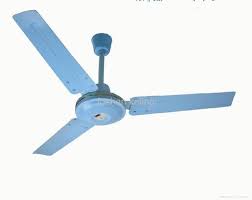
Though we find 3-blade ceiling fans more often, we come across, quite occasionally, ceiling fans with four blades and very rarely, five-blade fancy fans, also. We would never see a ceiling fan with six or more number of blades and surely never a fan with a single blade. Irrespective of the number of blades that a fan has, the inter-blade radial sectoral angles are always the same. In other words, the radial sectoral angle is 360/n degrees where n is the number of blades. For example, if the number of blades is 3, then the sectoral inter-blade angle is 360/3=120 degrees and when the number is 4 the angle is 90 degrees. This condition of similarity of inter-blade angles, ensures a zero net effective centrifugal force on the blades and thereby, avoids wobbling of the fan during its running.
Now let us know why we find 3-blade ceiling fans most often. We use any ceiling fan as a device to circulate air which in turn hastens evaporation of sweat leaving a sense of comfort to us. The circulation of air is caused when the fan blades chop the air in front of their leading edges and push the air downwards via their lagging edges. This is achieved by the slight bending each blade has along its length such that the leading edge is slightly above the lagging edge and by a gradually varying (usually decreasing) width it features along its stretch from the motor.
The fan can have more air to cut and push, in each of its revolution, if the inter-blade angle is as high as possible, meaning as low a number of blades (n) as possible. The air can be pushed down more briskly by repeated blows during the fan’s each revolution if the fan has more number of blades (n). In other words, in each revolution of the fan, when running, a higher number of blades, reduces the volume of the air to manoeuvre but renders brisk circulation and a lower number of blades increases the volume of air but reduces air speed. In order to achieve optimal results in both (more air and more gush), we strike a balance by not having too low (2) or too many (4 or more) a number of blades on a ceiling fan. For optimal usage and reasonable power management, the balance is struck with a 3-blade system of fans, most often.
Ref:http://www.thehindu.com/sci-tech/science/question-corner/article7302377.ece


